
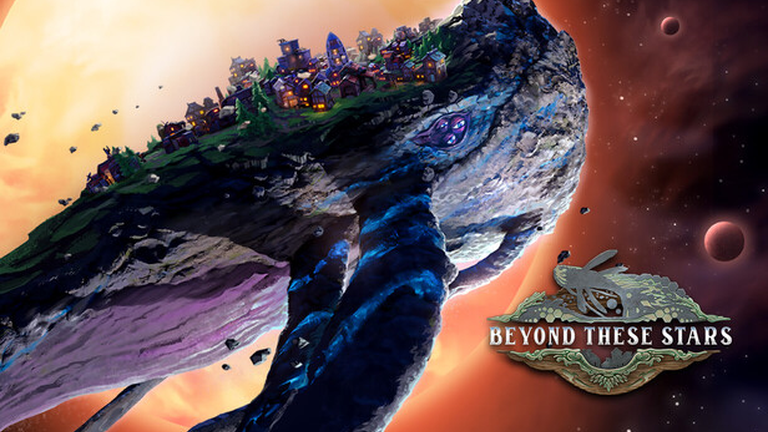
Introduction to Beyond These Stars
Have you ever imagined what it would be like to build a bustling civilization on top of a gargantuan, sentient creature soaring through the cosmos? If you are looking for a fresh perspective on the colony-sim genre, our Beyond These Stars review explores exactly what happens when you turn a living, breathing space whale into your hometown. Developed by Balancing Monkey Games and published by Hooded Horse, this title challenges players to balance intricate industrial supply chains with the emotional and ecological needs of a cosmic companion. In this comprehensive Beyond These Stars review, we break down everything from gameplay loops and survival mechanics to visual design and difficulty scaling.
Following humanity’s turbulent past where giant celestial cetaceans posed an existential threat, the survivors known as “Peeps” have returned to the surface. Rather than hiding underground, they now seek to coexist with these magnificent beasts. Establishing an air-breathing pocket of civilization on the back of a space whale named Kewa provides a breathtaking backdrop for a deeply tactical strategy game. Whether you are a veteran management gamer or a curious newcomer, understanding the complex interconnections of this title is crucial to avoiding catastrophic save failures.
Gameplay and Core Mechanics
At its heart, the gameplay loop revolves around establishing an initial outpost inside a small green patch of terrain near water on Kewa’s back. From humble beginnings—planting potatoes and constructing basic wooden huts—your society rapidly evolves. As you progress, you must construct complex logistics networks using roads, bridges, and elevators to navigate uneven and distant terrains.
Resource management demands constant vigilance. Raw materials like minerals and ores are strictly finite; once a mine is depleted, you must establish operations elsewhere. Furthermore, unwanted industrial byproducts can easily clog your factories, completely halting production lines if left unmonitored.
| Feature Category | Core Mechanic | Player Consideration |
|---|---|---|
| Agriculture | Soil composting & terraforming | Requires careful water management and topsoil application |
| Industry | Factory placement & logistics | Unwanted byproducts can clog and shut down production |
| Expansion | Roads, bridges, & elevators | Necessary to bridge uneven terrains across Kewa’s back |
| Sustainability | Pollution and waste control | High pollution turns tiles toxic and halts nearby factories |
Community reports indicate that managing pollution is one of the steepest early hurdles. If industrial zones are left unchecked, tiles turn toxic, rendering factories inside the affected area completely useless. Players must strategically position green spaces or utilize specialized cleaners to scrub the atmosphere clean.
The Symbiotic Relationship with Kewa
What truly sets this title apart from traditional management simulations is your connection with Kewa. Far from being a static game board or a simple pet, Kewa is a living entity with its own emotions, needs, and dreams for the journey through the universe. Maintaining a healthy relationship with your colossal host is just as vital as feeding your Peeps.
As you explore procedurally generated galaxies, you will occasionally need to establish outposts on nearby planets to harvest supplementary resources. However, community experiences highlight that you must carefully monitor Kewa’s patience. If you exploit the environment too aggressively or fail to keep Kewa happy, your companion might decide it is time to warp away from a star system before your planetary operations are fully secure.
| Relationship Metric | Impact on Gameplay | Management Strategy |
|---|---|---|
| Kewa’s Happiness | Dictates travel duration in star systems | Balance resource extraction with symbiotic harmony |
| Ecosystem Balance | Shrinks or expands habitable land | Plant trees and maintain green forests to spread atmosphere |
| Planetary Outposts | Provides rare supplementary goods | Monitor departure countdowns triggered by Kewa’s mood |
Terraforming plays a major role in maintaining this delicate ecosystem. By digging canals, adding topsoil, and cultivating dense forests, you expand the breathable air pocket on Kewa’s back. This active ecological maintenance creates an astonishing sense of immersion that few city builders achieve.
Modes, Replayability, and Difficulty
Balancing Monkey Games has packed the release version with three robust game modes: a story-driven campaign, an open sandbox, and focused scenarios. Each mode offers unique rule sets, ensuring high replayability. Because galaxies and terrain maps are procedurally generated, no two playthroughs unfold the exact same way.
However, prospective players should take note: this is not a casual, low-stakes cozy game. The learning curve is steep, and the intricate web of interdependent supply chains means a single mismanaged logistics bottleneck can cause your entire civilization to implode. Peeps can and will unionize or go on strike if their basic needs for food, housing, and health are ignored.
| Game Mode | Primary Focus | Recommended For |
|---|---|---|
| Campaign | Guided narrative and progression | Players learning the core mechanics and lore |
| Sandbox | Full customizability and unlimited resources | Creative builders looking to design massive metropolises |
| Scenarios | Specific tactical challenges and goals | Experienced strategists seeking a rigorous test |
According to community feedback on the Steam Store Page, the game rewards meticulous planning and punishes careless expansion. Introductory discounts and updates released shortly after launch have addressed minor localization and quality-of-life bugs, making it an ideal time to dive in for dedicated strategy fans.
System Requirements and Performance
Running a sprawling city simulation on the back of a moving, rendering 3D space whale requires a reasonably capable machine. Fortunately, the optimization is solid, supporting a wide range of hardware configurations.
| System Tier | Minimum Requirements | Recommended Specifications |
|---|---|---|
| Operating System | Windows 10 (64-bit) | Windows 10 (64-bit) |
| Processor | Intel Core i5-6600 / AMD Ryzen 3 3200G | Intel Core i5-9600 / AMD Ryzen 5 2600X |
| Memory (RAM) | 8 GB RAM | 16 GB RAM |
| Graphics Card | NVIDIA GTX 960 / AMD RX 570 (4 GB) | NVIDIA RTX 2070 / AMD RX 6600 XT (8 GB) |
| Storage Space | 7 GB available space (SSD recommended) | 7 GB available space (SSD recommended) |
Performance remains smooth even as your colony expands into a bustling metropolis, provided your system meets the recommended RAM and storage thresholds. Utilizing an SSD is heavily advised to ensure quick load times during procedural galaxy generation.
Conclusion
Our Beyond These Stars review concludes that Balancing Monkey Games has crafted a remarkably inventive and challenging twist on the traditional city-builder formula. By blending complex industrial automation, ecological preservation, and an emotional symbiotic bond with a sentient space whale, the developers have delivered a standout strategy title.
While its steep learning curve and unforgiving logistics management might overwhelm absolute beginners, seasoned simulation fans will find endless depth. The unique premise, gorgeous art style, and strategic variety make it an absolute must-play for anyone who has ever dreamed of building a civilization among the stars.
Frequently Asked Questions
What kind of game is Beyond These Stars?
It is a simulation and strategy city builder where players construct a thriving civilization on the back of a sentient space whale while managing complex supply chains and galactic exploration.
Is Beyond These Stars suitable for beginners?
The game features a helpful tutorial, but its intricate logistics networks, pollution mechanics, and steep learning curve make it better suited for experienced strategy and simulation players.
How many game modes are available at launch?
The game features three distinct modes: a narrative-focused campaign, a customizable sandbox mode, and challenging scenarios with specific objectives.
Do you have to manage more than just your city?
Yes! In addition to your colony’s industrial needs and Peeps’ happiness, you must maintain a harmonious relationship with Kewa the space whale and monitor ecological pollution levels to ensure long-term survival.